Included, Not Excluded – Every autistic learner. Every choice. Every future.
Author: Michelle Frangos, Head of Pastoral Tram House School
Contributor: Staff
8th March 2023 | 5 mins read
Sleep helps us to reset our bodies from the present day as well as preparing it for the following one. Many people suffer from sleep problems, which can also have an impact on their general health. For autistic people, and particularly children, sleep problems are more prevalent – estimates vary however, between 64 and 86% of autistic children have issues with sleep.¹ ² This could be anything from difficulty getting to sleep, night terrors or oversleeping.
At Tram House School we take sleep health very seriously and as such we are a Sleep Right recognised school. Below we’ll cover a few of the causes of sleep issues as well as some strategies and tips to help improve any sleep disturbances.
Autistic children having trouble sleeping can be caused by a range of factors.
If your child is having trouble sleeping, there are a number of things you can do to help improve their sleep pattern. If you suspect that it might be a medical problem or if sleep problems are causing your child difficulties throughout the day as well as at night, contact your GP in the first instance.
Before looking at individual solutions it’s important to try and work out the cause of sleep issues. Sleep diaries are a great way of creating an overall picture of the situation. It is important to include the following when constructing a sleep diary:
For more detail you can add in what activities they did shortly before bed, what their general mood was at bedtime and wake up, and anything else you think might be useful.
After a couple of weeks, patterns start to emerge that may point to where an issue lies. Perhaps they struggle sleeping at night when they’ve had a lengthy nap during the day, or they might have a disturbed night if they do a particular activity before bed.
Having a regular sleep routine is so important. Any significant changes to routine can have a detrimental impact on the body’s sleeping rhythm. Think of the impact that jet lag has after a long flight and how long it can take to recover from that.
The more structured the bedtime routine, the better. That way, your child knows what’s happening and when, limiting the chance of sleep disturbances. Visual timetables are great aids for this. You may want the timetable to cover 30 minutes or an hour before bed or even further back if you wish. Download our visual timetable or see some examples of things to include below:
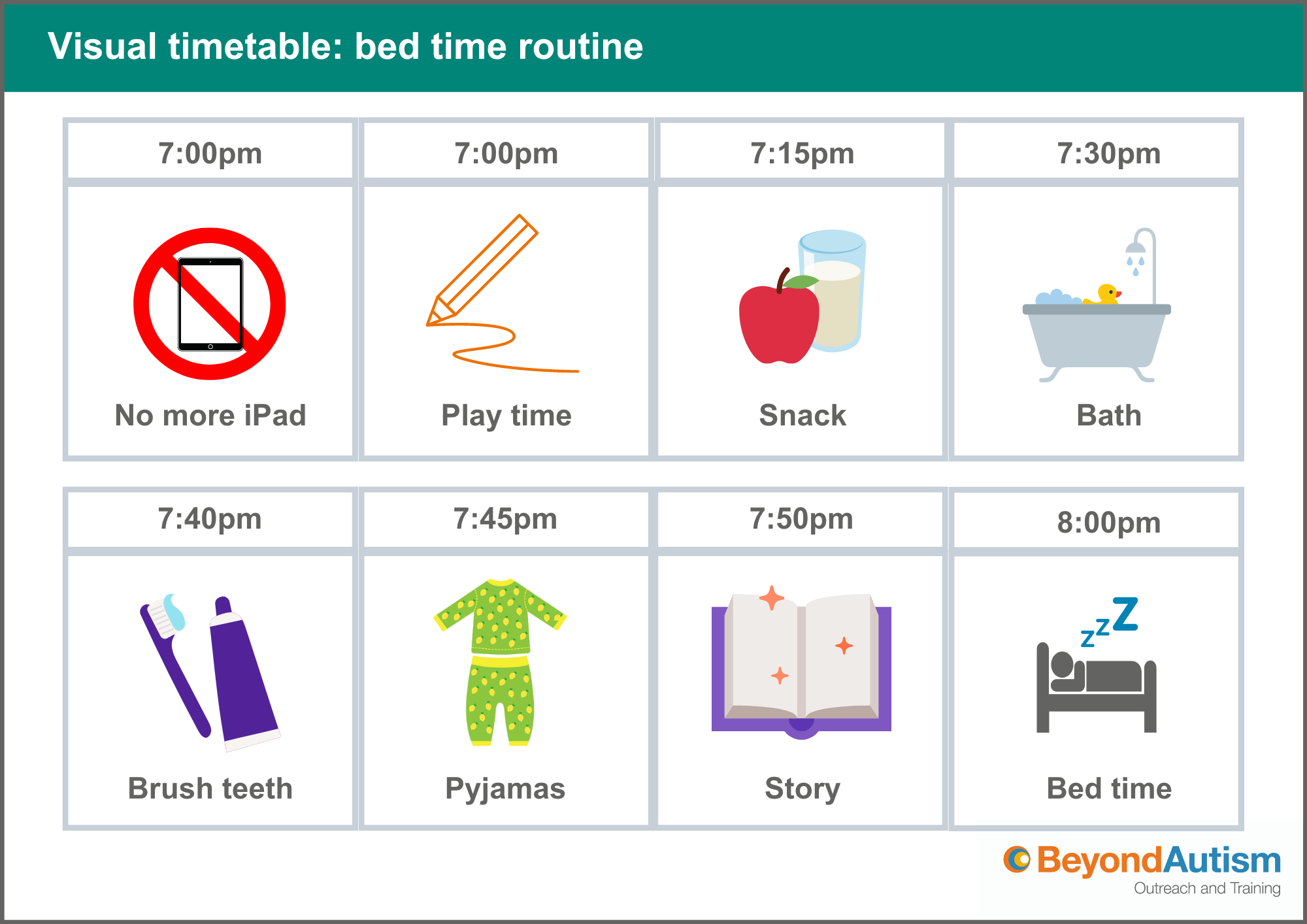
This is just an example of the sort of thing you could include. Each timetable will look very different depending on the child.
When it comes to sleep, the environment is just as important as the routine. Many sleep problems can be improved by altering the environment. Here are some things you can do:
If you are concerned about your child’s health or wellbeing in regard to their sleep, then you should contact your child’s doctor. They may choose to refer you to a hospital with a specialised sleep lab. If sleep problems are impacting on their learning, the school may also be able to support with sleep programmes. If your child has an EHCP, sleep can be included in the plan to receive additional support. Calming programmes or visual schedule support may be available from Occupational or Speech and Language Therapists.
Hunrosa also have a range of great online resources that you can access.
For more support for parents, head over to our resources page, or take a look at our free introduction to autism course.
1. K.B. van der Heijden et al (2018), Sleep, chronotype, and sleep hygiene in children with attention‑deficit/hyperactivity disorder, autism spectrum disorder, and controls, Journal of European Child & Adolescent Psychiatry, 27:99–111
2. Preeti Devnani and Anaita Hegde (2015), Autism and sleep disorders, Journal of Pediatric Neuroscience, 10(4):304-7

Share
Facebook
Twitter
LinkedIn
Email
WhatsApp
Messenger
Reddit
SMS