
Autism, mental health and wellbeing
Mental health and wellbeing are defined as a ‘state of wellbeing in which each individual realises his or her own potential, can cope with the normal stresses of life, can work productively and fruitfully, and is able to make a contribution to his or her community’ (World Health Organization, WHO).
All children and young adults will experience changes in their mental health whilst in schools and educational settings – it is important to remember it is completely normal to feel worried, anxious or stressed at times. However, it is also important we have the tools, strategies and support to manage these periods effectively. Some children and young adults may encounter significant life changing events which can seriously impact their wellbeing, and this can include mental illness.
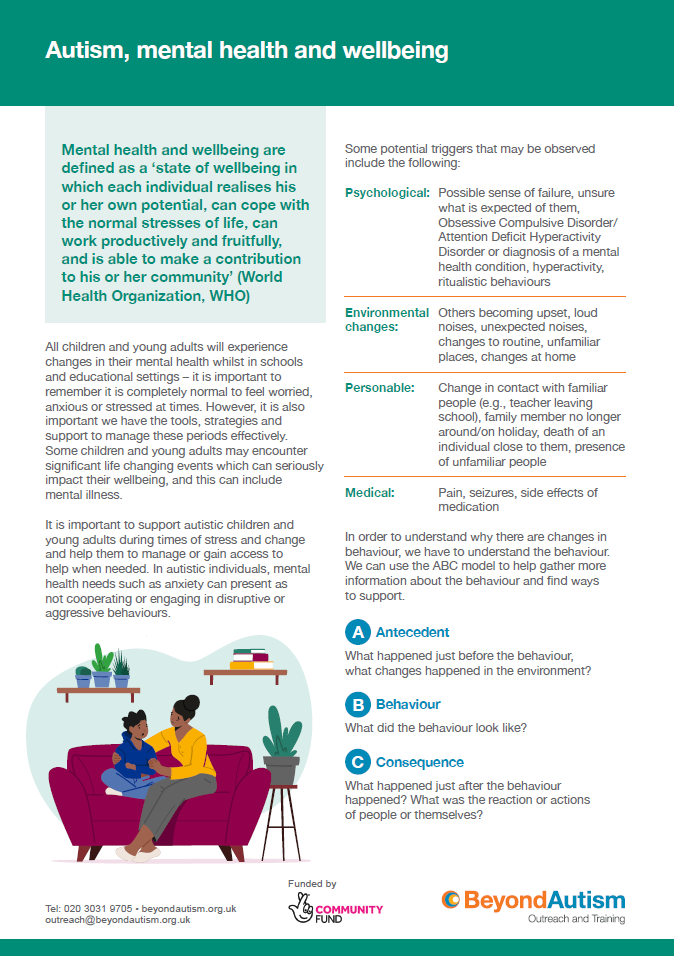
It is important to support autistic children and young adults during times of stress and change and help them to manage or gain access to help when needed. In autistic individuals, mental health needs such as anxiety can present as not cooperating or engaging in disruptive or aggressive behaviours.
Some potential triggers that may be observed include the following:
- Psychological: Possible sense of failure, unsure what is expected of them, Obsessive Compulsive Disorder/Attention Deficit Hyperactivity Disorder or diagnosis of a mental health condition, hyperactivity, ritualistic behaviours
- Environmental changes: Others becoming upset, loud noises, unexpected noises, changes to routine, unfamiliar places, changes at home
- Personable: Change in contact with familiar people (e.g., teacher leaving school), family member no longer around/on holiday, death of an individual close to them, presence of unfamiliar people
- Medical: Pain, seizures, side effects of medication
In order to understand why there are changes in behaviour, we have to understand the behaviour. We can use the ABC model to help gather more information about the behaviour and find ways to support.
Antecedent
What happened just before the behaviour, what changes happened in the environment?
Behaviour
What did the behaviour look like?
Consequence
What happened just after the behaviour happened? What was the reaction or actions
of people or themselves?
For example:
| Setting event (info from home) |
Antecedent (what happened just before the behaviour) |
Behaviour (what did the behaviour look like) |
Consequence (what happened immediately after the behaviour) |
| Slept only 5 hours, did not eat breakfast. | Unexpected noise. | Crying, hiding. | Access to ear defenders, a quiet space. |
See our factsheet on Understanding behaviours for more information.
To support your child’s mental health, the following skills can be taught:
Skills |
Strategies |
| How to communicate needs and wants | Teaching communication skills.
|
| Understanding emotions |
|
| Expressing emotions | Acknowledge and reward appropriate safe ways of expressing emotions e.g., “Thanks for telling me you are upset, let’s talk about it”. |
| How to use strategies to regulate their emotions and manage stress |
|
| How to make and maintain positive relationships with others |
|
| How to cope with change | Visual stories (see our resource ‘What is a visual story?’). |
Other general strategies
Invest time in special interests: Get involved with your child’s special interests or find extracurricular activities/groups they can attend. They may love cooking, music or art or they may love collecting specific items or building and creating. Try allocating time in the day in which you can engage with these activities. In doing so, you begin to associate yourself with things that they love and enjoy and they can continue to expand on their special interests which could turn into hobbies.
Create own structure through having choice: By providing choice for your child, they will feel they have some autonomy. You could offer simple options about an activity such as whether they want to do an activity now or later. You can also offer choice within an activity such as whether they want to go on the slide or on the swing. In providing choice, you highlight potential structure which in turn supports your child in anticipating when activities will occur.
By also providing alternatives, you are presenting them with options which they may not have chosen independently.
Spend time with friends or visiting places that they enjoy – schedule in some time where you and your child can be with significant people in their lives. Find activities that they may be able to engage in with their peers or schedule in some time to do activities or visit places they are familiar with and enjoy.
Rule out medical needs: If you have started to observe new, unexpected or an increase in behaviours in your child (e.g. more self-injurious behaviour or the sudden onset of tics) rule out any medical conditions. Keep a log of when the behaviours occur (see ABC above) so that you can speak to a medical professional, they can advise you.
Seek professional help: GP, SENDCo, clinical psychologist, social worker. Organisations available: CAMHS, Young Minds, The Children’s Society.
Share
Facebook
Twitter
LinkedIn
Email
WhatsApp
Messenger
Reddit
SMS