Included, Not Excluded – Every autistic learner. Every choice. Every future.
Author: Carrie Caceres-Taguiang, Outreach Consultant, and Emma Price, Head of Tram House School
Autism education, Understanding autism
Contributor: Staff
12th July 2024 | 5 mins read
If at all concerned about the mental health of a young person it is important that parents and families reach out to mental health services and professionals who will be able to help.
The Diagnostic and Statistical Manual of Mental Disorders (DSM5) 2013 highlights that autistic characteristics include the following:
A diagnosis of autism can often overshadow cooccurring conditions such as generalised anxiety disorder, obsessive compulsive disorder, depression and sleeping disorders. If all conditions aren’t addressed properly, this can impact upon individuals receiving adequate mental health support.
In addition to other diagnoses, a person’s early history can impact upon mental health, such as any adverse childhood experiences (ACEs) – below are some examples of what might constitute an ACE.
| Personal | Family members, home environment & neighbourhood |
|
|
The long-term impact of ACEs continues to be studied. One of the current findings has been that ACEs can lead to an overactive stress response system.² This means that for autistic children and young adults, they might see something which we consider to be minor, such as running out of milk in the morning, as a major emergency. This may be reflected in the behaviours that challenge that emerge from interruptions to routine.
There are several protective factors that can mitigate against ACEs – largely centred around building positive relationships with safe adults:
Regardless of need, the belief at BeyondAutism has always been that learners need to learn complex skills/coping strategies. We always look to support learners through their preferred method of communication giving them the tools they need to understand mental health and techniques to deal with their emotions.
We break down bigger topics such as bereavement into manageable steps, starting from ‘red’: essential skills and working up to ‘green’: more advanced skills (please see below as an example). When we break down skills into smaller steps, it allows all pupils, regardless of ability to have access to core skills and curriculum. As pupils master skills, introducing a differentiated curriculum can enable pupils to continue to be successful with more complex topics.
| Red boxes = must have skills. These are skills that are the most essential for a young person to have | Amber boxes = should have skills. These are skills that are considered necessary to a young person |
| Yellow boxes = good to have skills. These skills are good for a young person to have but aren’t considered the most necessary | Green boxes = nice to have skills. These are nice for a young person to have but are the most difficult to learn |
We use visual stories to support pupils with practical scenarios e.g. medical visits, going on holiday as well as more complex topics, for example the death of a family member or the breakdown in a relationship. Visual stories can support autistic learners in several ways, from overall understanding of complex topics to gaining a better understanding of routines and rules. For more advanced learners, it could allow them to reflect on how their behaviour might impact others or promote better self-awareness. Find out more about visual stories with our handy resource.
Another really useful tool is Zones of Regulation. We have several check-ins throughout the day: registration; start of each group lesson; end of day reflection where learners can share how they are feeling. Pupils also have specific Zones of Regulation targets, in their individual education plans, to help support them with recognising emotions in themselves, others and suitable strategies to help them to regulate . We recognise that learners will not always be in the ‘green zone’ and we teach them that that is ok. One of the most beneficial tools from the Zones of Regulation framework is it allows pupils to start to understand their and others’ emotions and recognise how they can best support themselves and others at all times and through the full range of emotions.
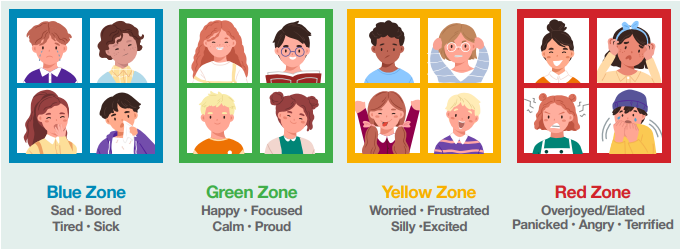
Debriefs can be a powerful tool to support a learner with their mental health and emotional wellbeing. We use a combination of symbols and Zones of Regulation to support learners in the aftermath of a mental health crisis. We use these for both the individual and anyone else who may have been affected e.g. if the individual shouted at or hit a peer:
As well as physical factors, it is important to also look at emotional risk factors, and how we can best mitigate against those risks. Examples of triggers may be noise in the environment; being unsure about expectations and environmental changes (a new classroom, new teacher etc.). Strategies to mitigate these triggers may include acknowledging the pupils’ feelings and teaching around asking to leave appropriately.
It is therefore important to utilise person-centred planning, trauma informed care and practice when supporting autistic individuals.
PCPs are tools that allow an individual to input about the decisions that affect them. This can include voicing the things they like and dislike, their interests and motivations, how their ideal day would look and how they want others to communicate with them. PCPs are therefore crucial to an individual’s mental health and wellbeing and are especially valuable with assisting in managing transitions, planning for the future and overcoming new challenges.
Each PCP will differ from person to person so it is also important to consider an individual’s values, which could be.
There is plenty that can be done to support the mental health of autistic children and young adults and what we’ve outlined above barely scratches the surface. Take a look at our Lunch and Learn session on the topic to delve into some of the ideas in more depth. Or if you want to speak to us about how we do things, or how we can support you, get in touch today.
1. Ambitious About Autism (2017), Know Your Normal
2. Panksepp, J. (1998). Affective neuroscience: The foundations of human and animal emotions. Oxford University Press.

Share
Facebook
Twitter
LinkedIn
Email
WhatsApp
Messenger
Reddit
SMS